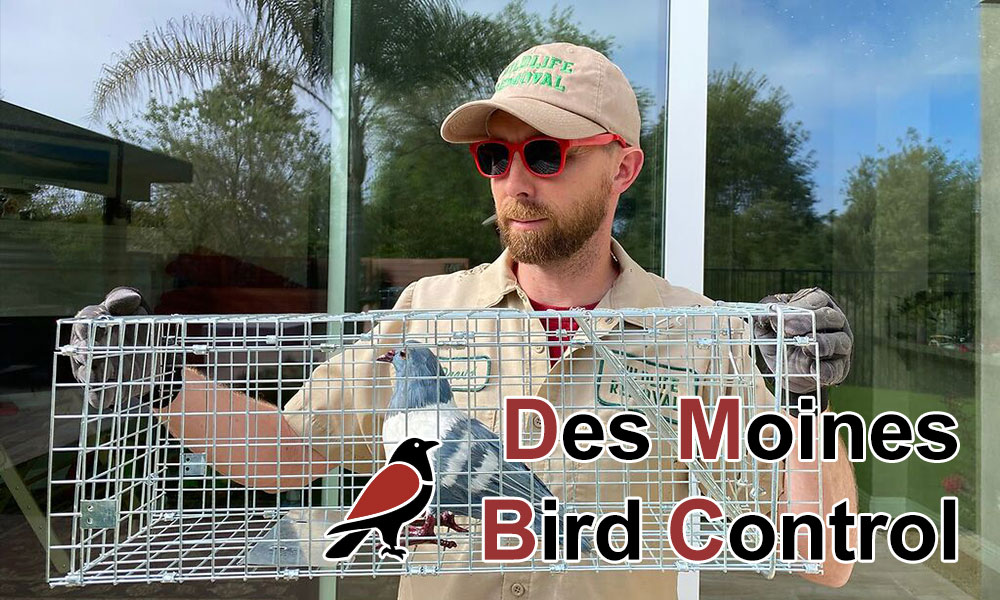
Welcome to Des Moines Bird Control: Prevention and Removal of Unwanted Birds
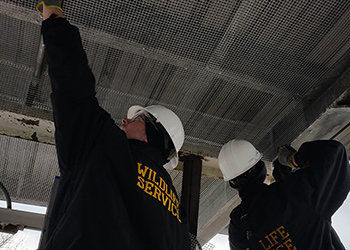
Our company specializes in resolving problems caused by birds in Des Moines, Iowa, both residential and commerical. We handle bird species such as pigeons, starlings, grackles, sparros, and even Canada Geese and woodpeckers. We generally don't kill birds - we prevent them from causing problems. Most commonly, this means that we install barriers that prevent them access to your building or property, or anti-roosting devices that prevent them from landing, nesting, or roosting on your home, store, building, or anywhere. We use netting, needle strips, shock track, and more. We do offer trapping in some cases, and removal of birds from warehouses, grocery stores, or other commerical or industrial buildings by netting or sometimes pellet shooting. We have a wide variety of tools and methods for solving every manner of bird problem. Call us at 515-203-3783 to discuss your bird problem today.Our Work
Full Range of Bird Control Services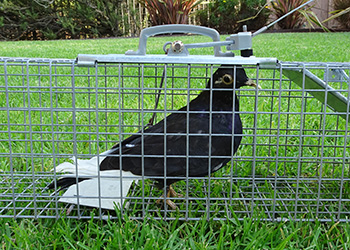
More About Us Des Moines Bird Control:
Our team of technicians is fully-equipped and comprehensively trained to deal with almost all suburban and urban bird species. As a part of our total protection service, we can provide you with a free online consultation, free on-site inspection, removal and exclusion, repairs and home modifications, and clean-up and sanitation. We can also provide follow-up services if deemed necessary. Unlike other companies, we will not stop when we get the birds out. Our experts can determine the cause and the source of the problems and provide the most detailed plan that will keep them at bay permanently. Over the years, we have received commendations and recognitions from various organizations and communities. Though we have become one of the major service providers in the area, we also do not forget to give back to the community. We remain active in all community activities and have been sponsoring local charity events. With this, we hope that we will be able to forge a long and lasting relationship with the community. We will not just deliver our services appropriately; we make sure that we will do it with a heart and respect. We aim to make this a pleasant and satisfying experience for all our customers.Pigeons in the Gutter: How to Stop Them
It isn't actually *that* common for pigeons to roost or land actually in the gutter of a house itself, unless you have guttering that is wide, large, or broken/damaged. Saying that, unlikely doesn't mean impossible, and we have personally encountered pigeons and other birds in the guttering.
Birds on the roof in general will have an effect on your guttering, especially when those birds start fouling up there. Nest-building material such as leaves, twigs and branches, can fall into the guttering system fairly easily as the birds carry it up there, and it also gets washed into the guttering if it's left lying on the roof. The odd leaf here and there won't be too problematic, but a build-up of garden/pigeon waste and debris can cause blockages, busted pipes, and even leaks inside the property.
The problem with pigeon poop is that it acts in the same way as concrete. So much so, in fact, that the animal uses it to reinforce its nest. When the birds first build a nest, it is a relatively flimsy construction. As the adult birds defecate on it, and then the baby birds after that, the nest gets stronger and stronger. The same applies with pigeon feces that ends up on your roof or in your guttering. It'll harden wherever it lands, and if that is in the guttering along with a bunch of leaves, you're going to have a gutter-dam in no time at all.
How to stop pigeons in the gutter
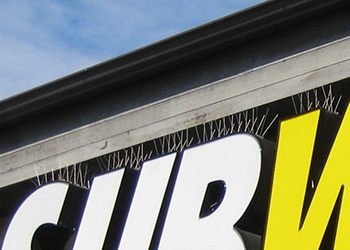
To prevent pigeons from getting into and onto the gutter and edges of the guttering, you have two choices. You can either use spike stripes or you can use wire-lines. Both have their pros and cons, and you should choose the option that will better fit the space you're trying to protect.
Wire-lines are easy to install and require nothing in the way of maintenance, but the same can be said for spike strips. Both are customisable and can be cut or created to fit a specific length or space, and both are relatively inexpensive. Spike strips cover more of a surface area, and when positioned on top of the gutter with a special attachment, can also prevent leaves and other debris from getting into the guttering itself. You will still need to clean away the leaves from the spike strips, but it'll be an easier job and less likely to result in a leak inside the building.
Wire-lines generally don't work in spaces that are quite wide because pigeons and other birds can lead either to the front or back of it. Wires that are installed down the centre of guttering still allow pigeons to land on the edge or rim of the pipe, and wires that are installed on the edge can still allow for pigeons and other birds to land in the pipe. Unless you are going to use a duo-wire system, slightly wider spaces are perhaps better treated with some spike strip action.
Whatever happens and whichever approach you decide to take, make sure that you commit to it. Install the device according to the instructions, and keep checking to make sure it's staying right where it should. If it starts to look clogged up with debris and waste (spike strips), or is looking loose and flimsy (wire-lines), you must fix it as soon as possible.
As well as making sure your preventative measures are in place, the removal of actual pigeon-material is important. If you do not clear away the feces that pigeons leave behind, it can have a corrosive action on the materials it comes into contact with, and this can once again lead to leaks and problems inside the building. The feces of animals also encourages flies and other bugs.
We have the most experience in Des Moines at understanding the nuisance birds of Iowa. Our 7 years of experience in the field ensures excellent results.
We pride ourselves on the quality of our bird control work. Our work is professional grade and long lasting, usually for the life of the building.
We are fully Iowa licensed. We carry the correct safety equipment, and operate in a safe and professional manner to keep your building and people safe.
Call us at 515-203-3783 to discuss your bird problem and our process. We are always responsive by phone. We can usually schedule next-day appointments, and provide written estimates for all our bird work.
Thank you Des Moines Bird Control for keeping the pigeons off of my storefront. My sidewalks are clean now!
These guys were the only ones who could get a sparrow out of my clothing store. Thank you!
Your goose abatement program has kept my golf course dropping-free. I recommend Des Moines Bird Control.